The 7-Day Sprint - How Accountability Sprints Work in AimHigh
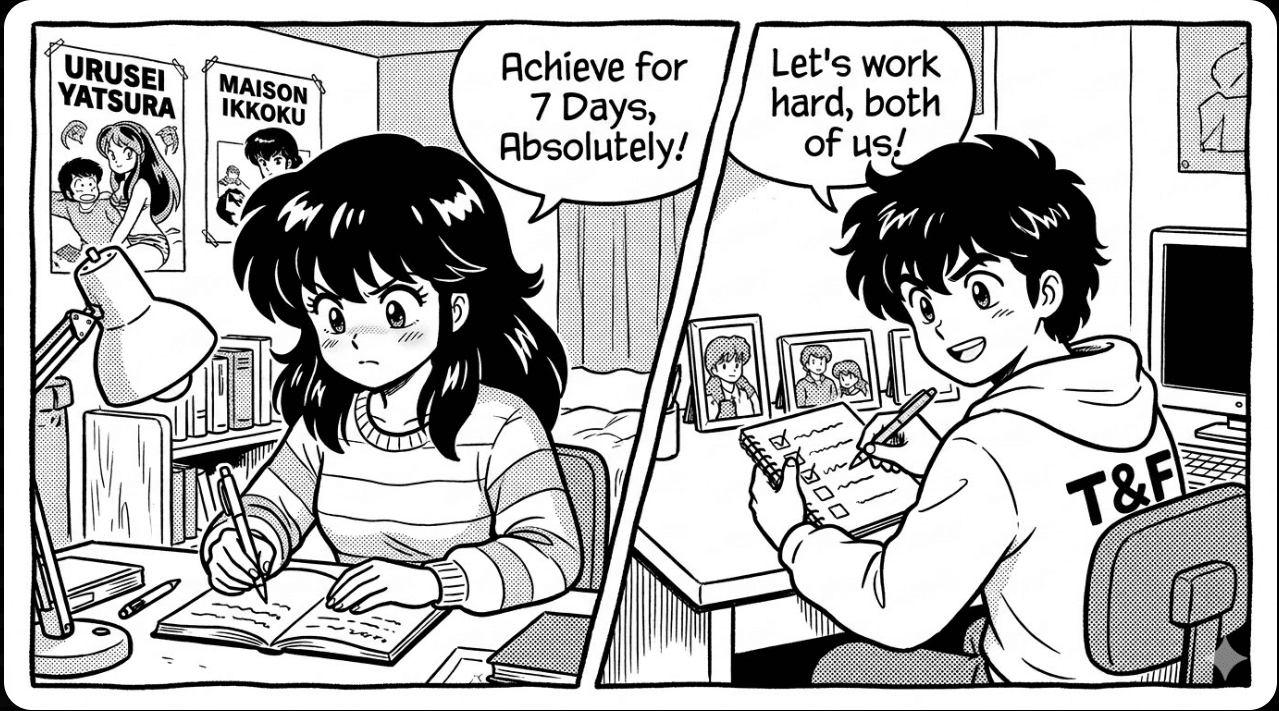
When I was designing AimHigh, I had to consider how long the accountability team-up should last.
In case you haven’t used AimHigh yet, the way the accountability sprint works is simple: you invite or are invited to team up with another user for exactly one week of mutual accountability. In this post, I want to expand on why it is designed to be for only a week and how a short-term sprint with the right partner changes everything.
The Anatomy of Failure: Why Long-Term Partnerships Collapse
When an accountability agreement spans months, it inevitably succumbs to three powerful behavioral economics principles that pull us off track.
1. Hyperbolic Discounting (The "I'll Do It Later" Trap)
Humans suffer from Hyperbolic Discounting, which means we value immediate rewards much more highly than future ones. If your goal is "Write a novel by December," that reward feels distant. The immediate satisfaction of watching a movie right now is much stronger. In a long-term partnership, "next week" always feels like an acceptable time to catch up, leading to perpetual delay.
2. Cognitive Load and Partner Fatigue
In a longer-term partnership, your context changes. You get new projects, new priorities, and your partner does, too. Keeping track of another person’s complex, evolving landscape is exhausting. This leads to Decision Fatigue and Cognitive Load. Eventually, you settle into the routine of it and you both start procrastinating—exactly what we don’t want to happen.
3. The Goal-Gradient Effect: The Missing Endline
Psychology teaches us the Goal-Gradient Effect, which states that our effort increases the closer we get to a goal's completion. A six-month goal has no visible finish line for the first five months. This creates a vast "middle-ground" where motivation plummets.
The AimHigh Fix: The Psychology of the 7-Day Sprint
The "Accountability Sprint" philosophy is simple: we leverage urgency and social psychology to create a high-stakes, low-fatigue environment. By compressing the timeline to just seven days, we neutralize the pitfalls of long-term planning:
- Sprints Beat Hyperbolic Discounting: A seven-day deadline is immediate enough that you can't push your work to "next month." The reward (or the social discomfort of failure) is looming, compelling immediate action.
- Sprints Leverage the Goal-Gradient Effect: From Day 1 of a 7-Day Sprint, the finish line is visible. Your brain shifts into high gear because you are always "almost there."
- Sprints Maximize Focus & Minimize Fatigue: A one-week commitment feels manageable. You can focus deeply on specific tasks (which AimHigh requires you to decompose into 15–60 minute actions) without worrying about what your goals might look like six months from now.
The 7-Day Secret Weapon: High-Context Partnering
A sprint is only as good as your partner. A generic "body in the room" provides passive support, but on AimHigh, I hope the partner provides Active Execution.
In a coffee shop, your neighbor provides Social Facilitation (their presence keeps you alert), but they lack Shared Context. They don’t know your specific task list. When you start an Accountability Sprint on AimHigh.life, you grant a partner visibility into your daily tasks and habits.
This shared context reduces Cognitive Load. You don't have to explain your whole work situation or the complexities of your goals to get motivation. Your partner can provide specific, surgical encouragement, like:
How to Select Your Perfect Sprint Partner
A One-Week Sprint is intense, but the time-bound nature means you can pair up with anyone from the AimHigh community, focusing on specific shared needs. When reviewing Community Profiles, don’t look for your new best friend; look for the right context:
- The Subject Matter Expert (SME): If your sprint Goal involves coding, learning to paint, or editing a podcast, pair up with someone whose profile lists skills relevant to that goal. They can provide high-value, specific feedback.
- The Shared Habit Partner: If your sprint Goals are focused on personal discipline (e.g., "Hit the gym 5 times this week"), pair up with someone who is tracking a similar habit. The shared struggle creates an immediate Social Contract—you are both trying to fulfill a promise you made together.
- The Chronotype Partner: Check their active hours on their profile. If you are an early morning deep worker, pairing with a night owl isn't helpful. Use chronotype pairing to ensure your partner is active during your core working blocks, leveraging Evaluation Apprehension (the healthy psychological pressure to stay on task because a peer is currently observing your progress).
Looking Ahead
Finally, I am also experimenting with "graduating" users to a 2-week sprint once they settle in to reduce the "paperwork" of finding another partner every week. I have a lot of ideas around this; however, I want to make sure that I back up my decisions with data as much as possible.
Ready to try a sprint? [Browse Community Profiles] on AimHigh.life and find your partner for the week.
Ready to transform your productivity?
Join AimHigh.life and find an accountability partner to help you achieve your goals.